
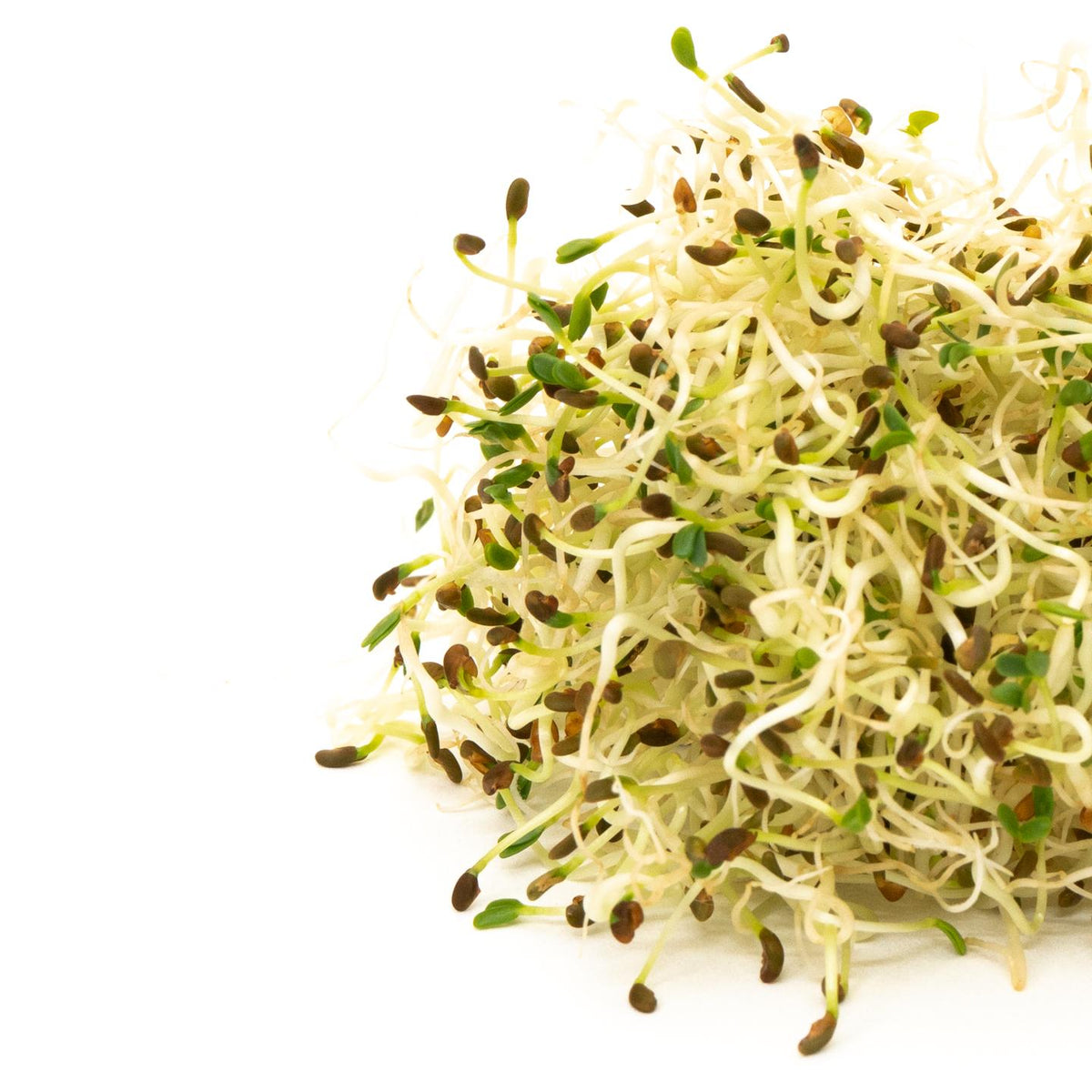
Alfalfa
5.0 · 216 reviewsAbout this seed
Alfalfa is an easy, fun sprout with a fresh flavor!
- Days to Sprout: 5 Days
- Soak Time: 4-12 hours
- Yield: Yield 1 tbsp. dry seed yields 1.5-2 cups of sprouts
- Storage: Our seeds should sprout well for a year after you purchase them if stored in a cool dry place. If you'd like to extend the germination life of your seeds store them in the fridge. If you store your seeds in the freezer they'll last even longer!
Sprouting Directions
Soak: Put 1-2 Tbsp. seed in a wide mouth jar with a sprouting lid. Add water, swirl, and drain. Refill jar with water and soak 4-12 hours. Drain well and invert jar at an angle on a sprouting or draining rack, or in a bowl or drain rack.
Rinse: Twice a day, refill jar with cold water, swirl, and drain well.
Enjoy! Ready to eat in 5 days. Refrigerate to store. (Sprouts store best when they are fairly dry. If you need to store immediately after rinsing, spin dry first.)
Nutritional information
“Phytoestrogens are naturally occurring plant-derived phytochemicals whose common biological roles are to protect plants from stress or to act as part of a plant's defense mechanism. Although composed of a wide group of nonsteroidal compounds of diverse structure phytoestrogens have been shown to bind estrogen receptors and to behave as weak agonist/antagonist in both animals and humans. Phytoestrogens include mainly isoflavones (IF) coumestans and lignans. These compounds are known to be present in fruits, vegetables, and whole grains commonly consumed by humans. IF are found in legumes--mainly soybeans--whereas flaxseed is a major source of lignans and coumestans are significantly present in clover, alfalfa, and soybean sprouts. 8-Prenyl flavonoids are common in vegetables. Bioavailability of IF requires an initial hydrolysis of the sugar moiety by intestinal beta-glucosidases to allow the following uptake by enterocytes and the flow through the peripheral circulation. Following absorption, IF are then reconjugated mainly to glucuronic acid and to a lesser degree to sulphuric acid. Gut metabolism seems key to the determination of the potency of action. Several epidemiological studies correlated high dose consumptions of soy IF with multiple beneficial effects on breast and prostate cancers, menopausal symptoms, osteoporosis, atherosclerosis and stroke, and neurodegeneration. For the relief of menopausal symptoms a consumption of 60 mg aglycones/day has been suggested; for cancer prevention a consumption between 50 and 110 mg aglycones/day is considered beneficial to reduce risks of breast | colon and prostate cancer; to decrease cardiovascular risk a minimum intake of 40-60 mg aglycones/day, together with about 25 g of soy protein has been suggested. For improvement in bone mineral density, 60-100 mg aglycones/day for a period of at least 6-12 months could be beneficial.” Forum Nutr. 2005;(57):100-11.Health effects of phytoestrogens. Branca F | Lorenzetti S.
“Studies in humans, animals and cell culture systems suggest that dietary phytoestrogens play an important role in prevention of menopausal symptoms, osteoporosis, cancer and heart disease. Broadly defined | phytoestrogens include isoflavones, coumestans, and lignans. Alfalfa sprouts, soybeans, clover and oilseeds (such as flaxseed) are the most significant dietary sources of isoflavones, coumestans, and lignans, respectively. A number of these compounds have been identified in fruits, vegetables and whole grains commonly consumed by humans. Proposed mechanisms include estrogenic and antiestrogenic effects, induction of cancer cell differentiation, inhibition of tyrosine kinase and DNA topoisomerase activities, suppression of angiogenesis, and antioxidant effects. Although there currently are no dietary recommendations for individual phytoestrogens, there may be great benefit in increased consumption of plant foods; especially sprouts such as Alfalfa, Clover and Soybean, and flaxseed.” A News Extract from the Annual Review of Nutrition | 17:353-381 1997 | DIETARY PHYTOESTROGENS By Kurtzer MS | Xu X
“The folacin content of alfalfa (Medicago sativa) and mung bean (Vigna radiata) sprouts was determined by Lactobacillus casei. Several variations of extraction procedures were tested. The optimum conditions for extraction were autoclaving mung bean and alfalfa sprouts in phosphate buffer containing 0.3% and 0.4% ascorbate | respectively | before homogenisation in a blender. The optimum blending time for folacin extraction was 120s for mung bean and 15s for alfalfa sprouts. Folacin content on dry weight basis increased several times in both types of sprouts during germination. Mature alfalfa and mung bean sprouts were found to contain 186 and 178 g folacin per 100 g fresh weight, respectively.” Journal of the Science of Food and Agriculture Volume 36 | Issue 11 | Date: November 1985 | Pages: 1155-1160. Folacin content of alfalfa and mung bean sprouts: The effect of extraction procedures and maturity Marilyn F. Magaram, Cynthia L. Stotts, Tung-Shan Chen, Christine H. Smith, Arlene J. Kirsch.
“Since alfalfa meal prevents hypercholesterolemia and atherosclerosis in rabbits and alfalfa saponins prevent the expected rise in cholesterolemia induced by dietary cholesterol in monkeys, the experiments being reported here were performed to determine whether alfalfa saponins affect atherogenesis in rabbits. In addition, the effects of alfalfa seeds were studied. Cholesterol-fed rabbits were randomly assigned to 3 groups: (a) control animals (N = 18); (b) animals maintained on a diet containing 1.0 to 1.2% alfalfa saponins (N = 18); and (c) animals maintained on a diet containing 40% alfalfa seeds (N = 17). Results after a 4-month observation period demonstrated that alfalfa saponins and alfalfa seeds reduce hypercholesterolemia, aortic sudanophilia, and the concentration of cholesterol in aortic intima-plus-media and in the liver, but do not induce changes in the hematocrit. ”Atherosclerosis. 1980 Nov;37(3):433-8. Alfalfa saponins and alfalfa seeds. Dietary effects in cholesterol-fed rabbits. Malinow MR | McLaughlin P | Stafford C | Livingston AL | Kohler GO.
Storage & germination
Our seeds should sprout well for a year if stored somewhere cool and dry. Keep them in the fridge or freezer to make them last even longer.
The freshest greens you can eat
Every green starts as a sprout. Grow them on your counter and you eat them minutes after harvest: crisp, living food, no truck, no clamshell. It takes a jar, a rinse twice a day, and a few days.
Growing Alfalfa
Soak
1–2 tbsp small seed or ¼–½ cup large seed in a wide-mouth jar. Soak 4–12 hours.
Rinse & drain
Rinse, drain, and tip the jar upside down at an angle, away from direct sun.
Harvest
Yield: 1 tbsp. → 1.5-2 cups. Let leafy sprouts sit half a day after the last rinse so they’re dry.
Store
Keep well-drained sprouts in the fridge.
Alfalfa as a full grown plant has one of the highest nutritional value among all foraging crops. Good for you and your cows!
Full growing directions
Rinse: Twice a day, refill jar with cold water, swirl, and drain well.
Enjoy! Ready to eat in 5 days. Refrigerate to store. (Sprouts store best when they are fairly dry. If you need to store immediately after rinsing, spin dry first.)
Helpful tips:
Some sprouts tend to clump together as they grow. To separate, fill the jar with water, remove the screen and stir gently with a fork during the regular rinse. Remove hulls if desired. Drain well as usual.
The drier they are the better sprouts keep. Be sure to let sprouts grow another half day after the final sorting rinse before storing in the fridge. Optional: put folded paper towel on top of the sprouts in the jar. Put lid on and refrigerate turned upside down. This removes excess moisture.
If your home is very warm during the summer months, it may help to rinse the sprouts three times a day with cold water. Stir gently if clumping.
To remove the hulls and unsprouted seeds from leafy sprouts, use a special sorting rinse. Pull sprouts out of the jar into a large bowl filled with water. Swish gently using fingers to separate the tangled roots. Most hulls will separate and rise or sink. Discard the hulls. Collect the sprouts back to the jar with or without aid of a strainer. Return the sprouting closure and drain so you can continue for half a day more of sprouting.
Some brassicas (cabbage family) like radish and broccoli develop very fuzzy root hairs the longer you leave them undisturbed and these can be mistaken for mould. You will even see these after a few days of storage in the fridge. Stirring and rinsing removes the root hairs for a time.
Fresher than the store, for less
| Compare | Grow your own | Store-bought sprouts | Store-bought microgreens |
|---|---|---|---|
| Freshness | Harvested minutes before you eat | Days in a truck and on a shelf | Cut days before you buy |
| Cost | Around 30¢ a cup* | Paid by the clamshell | Paid by the clamshell |
| Organic | Certified organic, every seed | Sometimes | Sometimes |
| Safety | Every seed lot lab tested before it ships | Varies by grower | Varies by grower |
| Variety | 100+ seeds and blends | Usually alfalfa or broccoli | A few kinds |
| Packaging | One bag of seed, many harvests | A plastic clamshell every time | A plastic clamshell every time |
*Estimate based on 125 g of Alfalfa ($7.37 CAD), about 15 tablespoons, each growing 1.5–2 cups of sprouts.
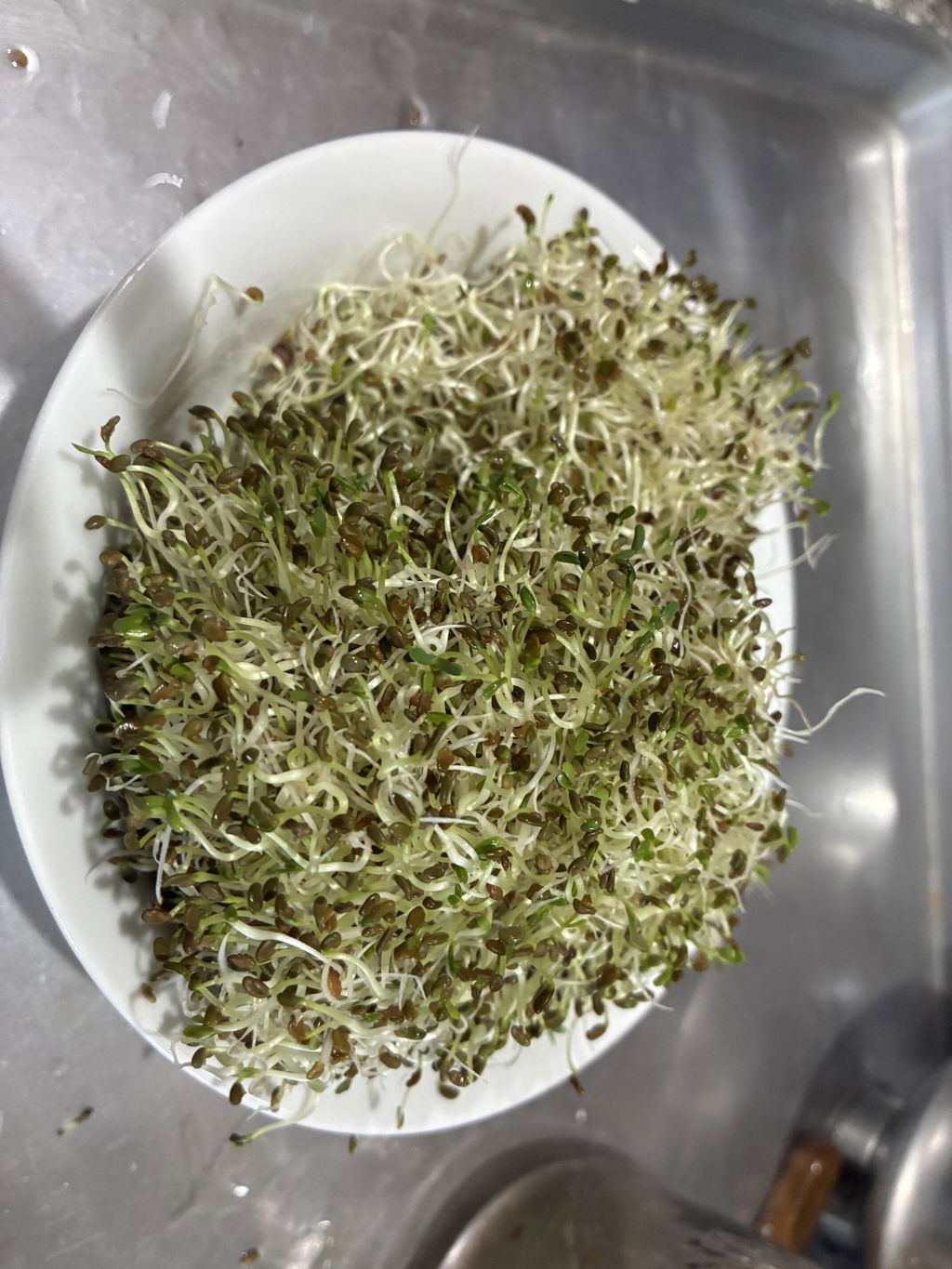

Let’s grow together
We care deeply about people and the planet. As a second-generation family business, farming organically since 1974, we source top-quality organic seed, many from small farms here in Saskatchewan, and test every lot so you can grow with confidence.
Good questions
I’ve never sprouted. Will this work for me?
Yes. If you can rinse a jar twice a day, you can grow sprouts. Every seed page lists its soak time and days to harvest, and our How to Grow Sprouts guide walks you through it.
What do I need to get started?
A wide-mouth Mason jar and a sprouting lid is all it takes. Our lid fits any wide-mouth jar. Not sure? Build a starter kit and save 5% when you pick 3 or more seeds.
Are your seeds safe to sprout?
We sample every lot as it arrives and send it to an independent lab for Salmonella and E. coli testing. Seed stays quarantined until it’s cleared, and we’re audited every year to the FSSC 22000 food safety standard. Read more about safety.
What’s the difference between sprouts and microgreens?
Sprouts grow in a jar in 2–5 days and you eat the whole thing, seed and root. Microgreens grow in a tray for 1–3 weeks and you cut the leafy tops. Many of our seeds work both ways; each seed page says which.
How does subscribe & save work?
Choose subscribe & save on any seed to get 5% off, delivered every 30, 60 or 90 days. You can skip, change or cancel anytime from your account.
How much does shipping cost?
Shipping within Canada is a flat $9, and free on orders over $75. Orders to the United States ship free over $100. We ship from our family farm in Saskatchewan.
Do you sell bulk seed for commercial growers?
Yes. Most seeds come in 1 kg and 5 kg sizes, and we have resources for commercial growers. Contact us about wholesale pricing.
Build your starter kit in 3 steps
Pick your sprouter, choose seeds you’ll love, and save 5% when you choose 3 or more.


